
Photo: Andrej Jakobčič, Wikimedia Commons, CC BY-SA 3.0. Image cropped and resized.
Overview
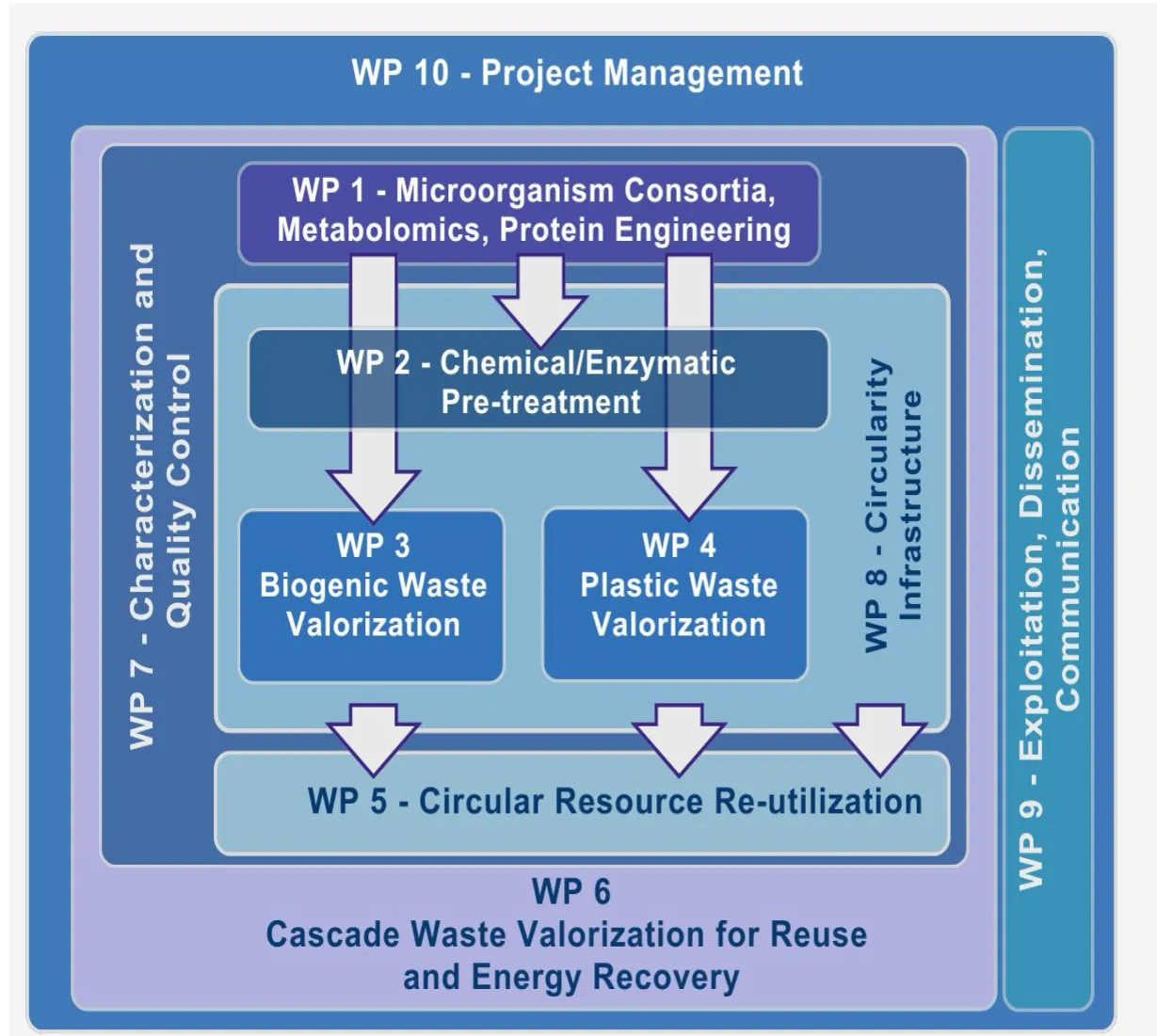
The POLYLOOP starts with the evolution of microorganisms, coupled with metabolomics studies and protein design, specifically targeting the degradation of plastic and bio packaging waste in WP1. WP3 and WP4 focus on valorising bio and plastic-packaging waste to produce secondary raw materials (sRM), oil, and alternative fuels. WP5 centres on validating the outputs of WP3 and WP4, while WP6 closes the process loop by addressing liquid and solid wastes generated throughout WP1-WP5. Over 80% of wastewater will be recycled or tested for hydrogen (H₂) production, and solid wastes will be converted into alternative energy sources. Horizontal WP7 and WP8 encompass comprehensive characterization and circularity infrastructure, including data management, life cycle assessment and costing (LCA/LCC), digital passports, safety and sustainability by design (SSbD,) applied across WP1-WP6. Collaborative stages embrace a holistic and multidisciplinary approach, targeting energy and climate benefits and promoting carbon circularity. This approach facilitates a multidimensional exploration of the strengths and limitations of various plastic and bio-waste recycling technologies.
WP1: Advanced Applications of Microorganism Consortia, Metabolomics and Computer-Assisted Protein Engineering for Enzymatic Degradation of Polymers
WP leader: Urban Bren, FKKT, M1-M36
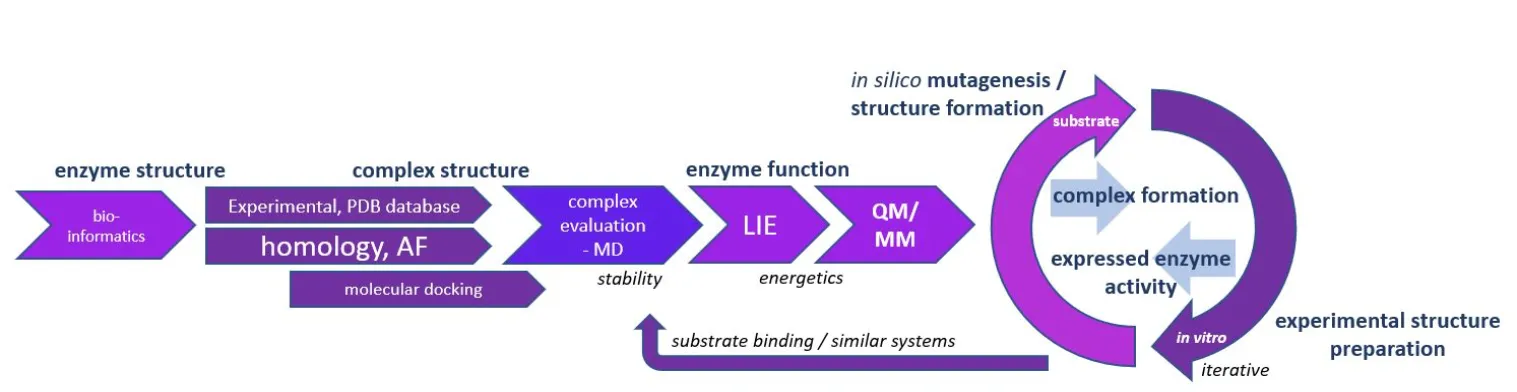
Objectives: Investigation of microbial consortia or pure cultures that can degrade polymers by enzymes they encode. The enzyme function encoded by the present microbes will be predicted from genomic data in congestion with transcriptomics and metabolomics. The identified enzymes will be enhanced with the help of extensive molecular dynamics simulations and advanced free-energy calculations. Optimization of the degradation process will be performed by the application of the best-performing microbial consortia or pure cultures in combination with engineered enzymes, enzyme cocktails, enzyme encapsulation and sequential treatments with microbes/enzymes or enzymes/microbes for a more efficient polymer breakdown and product formation and valorisation.
WP2: Chemical/Enzymatic Pre-treatment, Decolorization, and Removal of Auxiliary Substances
WP leader: Milena Horvat, JSI, M2-M18
Objectives: (i) Develop and assess efficient processes for decolorization and removal of auxiliaries across various plastic and natural polymers, as well as blended waste packaging waste streams. (ii) Investigate and refine approaches using plasma activation, UV/ozone treatment, ultrasonic treatment, and natural-based surfactants for packaging waste. (iii) Explore recycling opportunities for supercritical CO2 and develop a computational model to optimize microwave-based processes for packaging materials. (iv) Address challenges related to the valorization of waste streams for applications such as HMF and LA.
WP3: Biogenic Waste Valorization
WP leader: Blaž Likozar, NIC, M3-M24
Objectives: (i) The main objective of WP3 is to optimize chemical and enzymatic recovery/transformation process via depolymerization of natural packaging (cellulose & lignocellulose). (ii) The efficiency of cellulose removal (packaging & mixtures) will be enhanced using new mixture of enzymes from WP1. (iii) Furthermore, the extent of cellulose, lignocellulose depolymerization will be determine with different catalysts and solvents in a batch reactor and the reactive equilibrium will be determine, which prevents higher conversions and yields. (iv) The objective of this WP is also to selectively produce value-added chemicals from HMF-rich lignocellulosic biomass waste stream by implementing magnetic heating (MH). (v) This work package aims to advance lignin valorization through innovative strategies that integrate catalytic and modelling approaches. Development of lignin-based epoxy resins designed to possess self-healing properties or to be recycled by chemical processes.
WP4: Plastic Waste Valorization
WP leader: Željko Knez, FKKT, M5-M30
Objectives: The aim of WP4 is the detailed investigation of the hydrothermal degradation of different polyolefins (HDPE, MDPE, LDPE, LLDPE, PP, blends) in different forms (pellets, film) by SCW. The secondary products (oils and gases) obtained from the proposed HP have enormous potential for use as fuels or as a source of various chemicals. The main objectives are: (i) Characterization of feedstock materials. (ii) Hydrothermal degradation of various polyolefins such as LDPE, HDPE, XPE using supercritical water SCW. (iii) Optimization of process conditions to maximize oil phase recovery. (iv) Determination of the yields of the degradation products, including gas, solid, and oil phases. Qualitative and quantitative analysis of the composition of the oil and gas phases. Evaluating the potential of the oil and gas phases for use as fuel.
WP5: Circular Resource Reutilisation
WP leader: Vanja Kokol UMFS, M4-M32
Objectives: (i) To evaluate secondary Raw materials (sRM) for reuse in the production of chemically mono-material products. (ii) To reformulate the materials used in bio-adhesives, resins, plastic manufacturing with additives that improve their recycling, or rheological and mechanical properties and compatibility with other polymers to be more resistant to processing. (iii) To evaluate their upcycling in new applications and products with a higher proportion of bio-based materials, be easier to recycle. (iv) To evaluate WP4 fuels for electricity generation and assess the feasibility of scalable modular microgrids that use waste-derived fuels to produce electricity and supply it back to waste treatment processes.
WP6: Circular RCascade Waste Valorization for Reuse and Energy Recoveryesource Reutilisation
WP leader: Aleksandra Lobnik, FS, M7-M36
Objectives: (i) To close the knowledge gaps in terms of providing a complete description of the generated solid residue, wastewater, and their potential application in energy and material recovery processes. (ii) Several waste liquid and waste solid pilots are located at UMFS, IJS: liquid waste management with more than 80% reused water and solid waste valorization in terms of energy production.
WP7: Characterization and Quality Control
WP leader: Matjaž Finšgar, FKKT
Objectives: (i) To establish analytical procedures and methodologies across the project. (ii) To perform in-depth chemical, physical, and structural characterization of input materials, intermediates, and final products. (iii) To integrate advanced analytical techniques to monitor process efficiency, product quality, and environmental impact. (iv) To provide critical data to support the optimization and scale-up of processes developed in WP2-WP6. This analytical framework integrates techniques to effectively achieve project objectives. With the instruments at FKKT, JSI, FS, NCI (Orbitrap MS, NMR, XRD, GC-MS, HPLC, SEM, TEM, GPC, TEM), FKKT UM (FTIR, UV-Vis, GC-MS, HPLC, TGA, DSC, ITC), FS UM (SEM), NCI (Raman, XRD, NMR, GPC, TEM), (HPLC, GC-MS, TGA, DSC), the project is able to thoroughly characterize and optimize processes and products. The combined expertise and advanced resources will ensure that the sustainability and innovation goals of the project are achieved efficiently.
WP8: Circularity Infrastructure
WP leader: Lidija Fras Zemljič, FS, M1-M36
Objectives: This WP aims to evaluate the environmental, economic, and societal impacts of the innovative waste treatment technologies developed in the project. (i) It encompasses life cycle assessments (LCA), life cycle costing (LCC), and social life cycle assessments (s-LCA), supported by (ii) advanced data management systems and the development of a digital product passport. (iv) It will ensure that the Digital Product Passport not only meets but exceeds EU requirements by providing a secure, transparent, and interoperable framework for data management, thereby supporting the broader goals of sustainability, traceability, and a circular economy. (v) Finally, the safety profile will be insured and analyzed in accordance with EU regulations and requirements.
WP9: Exploitation, dissemination, communication
WP leader: Aleksandra Lobnik, FS & Milena Horvat, IJS, M1-36
Objectives: To implement a comprehensive communication, dissemination, and exploitation programme to disseminate project results to relevant stakeholders.
WP10: Project Management
WP leader: Željko Knez, FKKT, M1-M36
The main tasks will be dedicated to (1) administrative and financial reporting, (2) time management and coordination, (3) organizing and chairing consortium meetings, (4) managing any risk during the project implementation, and (5) securing project dissemination and outreach as proposed by the project.